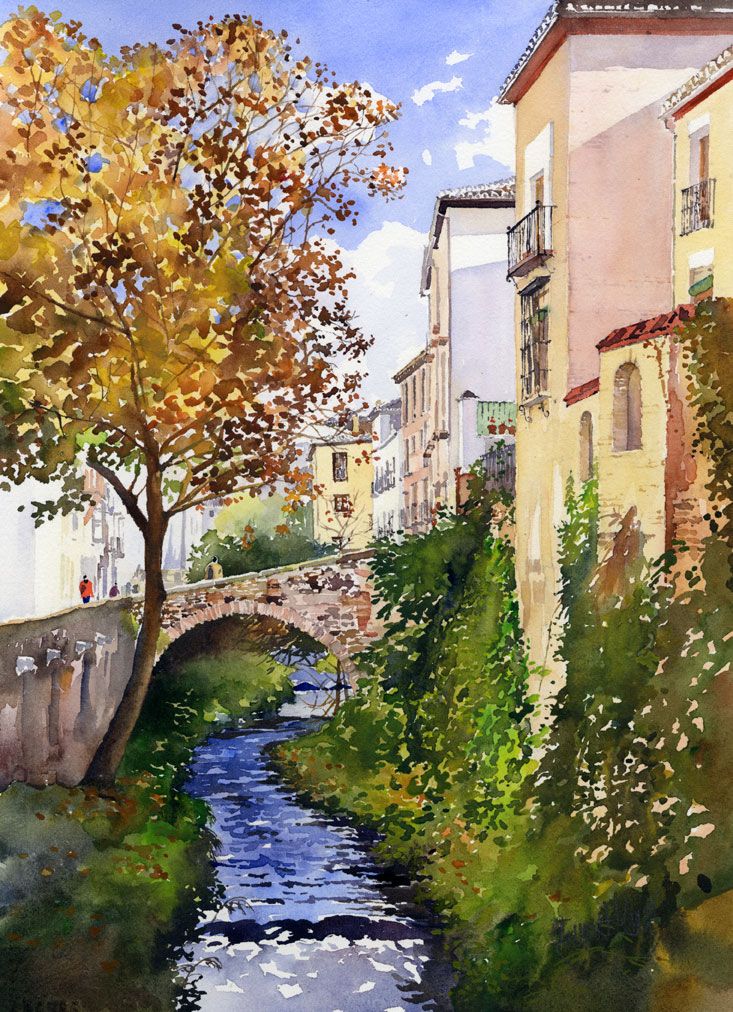
En su nuevo álbum, Granada recibe a Raúl con luz de primavera, le pone entre las manos el sol de Plaza Nueva; mientras, le dice que le quiere la Torre de la Vela y descubre en su perfume barquillos de canela. Luego resbala por el hilo que alcanza una cometa, porque hay magia por el aire rondando en las aceras (1).
Y es que Raúl Alcover no es un músico más, sino un cantautor lírico granadino que ha sobrevivido a décadas de cambios en la industria, manteniendo intacta su esencia. Los premios, reconocimientos y nominaciones están ahí, aunque lo que realmente cuenta es su apertura a mezclar géneros preservando el alma musical de su ciudad.
Desde los quince años, cuando se metió de lleno en el colectivo cultural andaluz Manifiesto Canción del Sur, ya estaba claro que no iba a ser un artista de manual: era un inconformista, un explorador de sonidos. Su versatilidad es muy amplia: folk, flamenco, bossa nova, jazz, pop, rock, balada… todo cabe en su universo.
Artistas como él no hacen música solo para complacer, sino por compromiso social y necesidad vital. Su nuevo trabajo Toda la noche oyeron pasar pájaros fue presentado en octubre de 2025, y estará disponible en CD en enero de 2026. Ha sido producido por Pablo Salinas.
Con todo lo anterior en mente, y con la mayoría de las preguntas centradas en este último álbum, comienzo mi entrevista:
MARÍA: Raúl, primero me gustaría que volviéramos a tus inicios como músico. Creo que tenías quince años cuando te uniste a Manifiesto Canción del Sur ¿es correcto? ¿Cómo recuerdas aquel momento?
RAÚL: Me uní a Manifiesto con apenas quince años y supuso despertar mi conciencia andaluza y pelear por mi tierra.
M: Tu apellido es Alcover y has comentado antes que tu familia viene de Granada y de fuera de Granada ¿por casualidad tienes algún parentesco con el poeta mallorquín Joan Alcover?
R: Que yo sepa no. De todos modos Alcover es un apellido común en las zonas catalana y mallorquina.
M: En tu obra hay una presencia constante de la poesía. Sé que has trabajado con versos de Lorca y de Javier Egea. ¿Qué lugar ocupa para ti la poesía dentro de la música? ¿Crees que la poesía es un territorio paralelo al de la música, o que ambas se funden en un mismo fluir de expresión?
R: Hago canciones que como sabes se componen de letra y de música. Cuido la letra tanto o más que la música. Y van de la mano.
M: Sí, se nota… Por cierto, en este último trabajo ¿quién es el autor de la letra de las canciones?
R: Las letras son mías excepto Rastros (3) y Ella no sabía nada (2)…de Javier Egea. El disco llevará más temas. Es un adelanto y un guiño a Javier, con el que hice Noche canalla, una de mis canciones más famosas y mejores.
M: ¿La musicalización de Noche canalla ocurrió antes de la tragedia de Javier o a posteriori?
R: Mucho antes de morir…En 1981. Noche Canalla nace independiente. La Tertulia organiza un concurso de letras de tango argentino en Granada y se decide que quien debe poner música a la letra ganadora sería yo. Y ganó Javier con ese poema.
M: ¿Entonces Noche Canalla es un tango? Fantástico…
R: Que yo hice balada.
M: Otra musicalización tuya de un poema de Javier Egea, Ella no sabía nada (2), la acabo de oír; tu musicalización y la grabación la hacen todavía más especial, qué belleza.
R: Quería hacer de ella una breve sinfonía.
M: ¿Quién ha diseñado la portada de Toda la noche oyeron pasar pájaros?
R: La portada y diseño del disco es obra de Lady Desidia.
M: Gracias por responder a las preguntas de El Artca.
R: Gracias María.
………………………..
Graná es de grana: tanguillos granadinos con toque de cumbia, letra y música R. Alcover (1)
A la deriva, pop-blues letra y música Raúl Alcover
Ella no sabía nada, sinfonía breve de Raúl Alcover con letra de Javier Egea (2)
Teresita, vals-bulería inspirada por la pianista colombiana Teresita Gómez, letra y música R. Alcover
Rastros, bossa nova: música de R. Alcover, letra Javier Egea, guitarra Miguel Ángel Corral (3)
Geología, rock sinfónico inspirado tras leer un relato de María Alcázar, letra y música R. Alcover (4)
THE MUSICIAN THAT CARRIES THE SUN OF PLAZA NUEVA IN HIS HANDS
By María Martínez Sánchez
In his new album, Granada welcomes Raúl with spring light, it puts the sun of Plaza Nueva in his hands, while telling him that the Torre de la Vela loves him, and he discovers cinnamon wafers on its perfume. Then he slides down the thread that reaches a kite, because there is magic in the air singing on the sidewalks. (1)
Because Raúl Alcover is not just another musician but a lyrical songwriter-singer from Granada who has survived decades of changes in the industry, keeping his essence intact. The awards, recognitions and nominations are there, although what really counts is his openness to mixing genres while preserving the musical soul of his city.
From the age of fifteen, when he fully immersed himself in the Andalusian cultural group Manifesto Canción del Sur (Manifesto Song of the South) it was already clear that he was not going to be a standard artist: he was a nonconformist, an explorer of sounds. His versatility is very wide: folk, flamenco, bossa nova, jazz, pop, rock, ballads… everything fits in his universe.
Artists like him do not make music just to please, but out of social commitment and vital necessity. His new work, Toda la noche oyeron pasar pájaros (All night they heard birds passing by) was presented in October 2025 and it was produced by Pablo Salinas. It will be available on CD in January 2026.
With all this in mind, and with most questions concerning this latest album, I begin my interview:
MARÍA: Raúl, first I would like us to go back to your beginnings as a musician. I think you were fifteen years old when you joined Manifesto Canción del Sur, is that correct? How do you remember that moment?
RAÚL: I joined Manifesto when I was barely fifteen years old and it meant awakening my Andalusian conscience and fighting for my land.
M: Your last name is Alcover, and you have mentioned before that your family comes from Granada and from outside of Granada, are you by any chance related to the Majorcan poet Joan Alcover?
R: Not that I know of. In any case, Alcover is a common surname in the Catalonian and Majorcan areas.
M: In your work there is a constant presence of poetry. I know that you have worked with verses by Lorca and Javier Egea. What place does poetry occupy in your music? Do you think that poetry is a parallel territory to that of music, or that both merge into the same flow of expression?
R: I compose songs that, as you know, are made up of lyrics and music. I care about the lyrics as much or more than the music. And they go hand in hand.
M: Yes, it shows… By the way, in this latest work, who is the author of the lyrics of the songs?
R: The lyrics are mine except for Rastros (Footprints) (3) and Ella no sabía nada (She didn’t know anything) (2) by Javier Egea. The album will have more songs. It is a preview and a nod to Javier, with whom I made Noche Canalla (Rogue night), one of my most famous and best songs.
M: Did the musicalization of Noche canalla happen before Javier’s tragedy or afterward?
R: Long before he died…In 1981. Noche Canalla was born independent. La Tertulia organizes an Argentinian tango lyrics contest in Granada and it is decided that the person who should set the winning lyrics to music would be me. And Javier won with that poem.
M: So Noche Canalla is a tango? Fantastic…
R: That I made a ballad.
M: Another musicalization of yours of a poem by Javier Egea, She didn’t know anything (2), I just heard it; your musicalization and the recording make it even more special, what a beauty.
R: I wanted to make it a short symphony.
M: Who designed the cover of All Night They Heard Birds Going By?
R: The cover and design of the album is the work of Lady Desidia.
M: Thank you for answering El Artca’s questions.
R: Thank you Maria.
……………………………
Geology (lyrics by Raúl Alcover) (4)
I contemplate on the mirror the geology of my image, the bark cracks of the passing of the years with the shadows of earthquakes I have lived, the kisses of oblivion, the marks of much laughter and disappointment, the creases guard my eyes, in my eyelids, signals of sadness and joy, in between my eyebrows there are faults reversed in harmony. Now I am soil in evolution, rock that does not provoke any wind of jealousy, nor does it make to doubt, and consience and reasoning are the ones who marked my forehead with their mineral finger, with their mineral finger. I discover on the mirror and on my face an atom of time, a valley of sanity, a river of enthusiasm and freedom, an unforgettable volcano of passion. And even though the mirror does not speak, it knows my earthquakes are born in the human depths of the heart, I search without fear my face on the mirror, and point at the path my tears should follow, the grooves they would open until they reach my mouth salted with sea drops.
Busca en los propósitos de la tarde una escoba y un recogedor para ir juntando los fragmentos de la vida. Como aquél en que te cuidaba la fiebre, y a eso de las siete comimos de la comida china que nos regaló el hermano de Pepe. La cobija se te escurría por los hombros, la piyama blanca con flores rositas, te veías desaliñada, triste. Será porque me vine a vivir contigo, pensé, pero nunca te lo dije. Una vez te vi, con tu pelo negro, me perseguía una idea perturbadora, guardé silencio y tus manos se agrietaron, te llenabas de pigmentaciones, la piel se escurría, vi la enfermedad y la tristeza de tus ojos marchitos, vino el tiempo de golpe y me arrojó la decrepitud. Me veía horrorizado ante tu muerte, no soporté la idea de cuidar de ti y comenzó el infierno.
By Lunnático
Look for a broom and a dustpan in your afternoon resolutions to gather the fragments of life. Like the one where I took care of your fever, and around seven we ate the Chinese food that Pepe’s brother gave us. The blanket was slipping off your shoulders, the white pajamas with pink flowers, you looked disheveled, sad. It must be because I came to live with you, I thought, but I never told you. Once I saw you, with your black hair, I was haunted by a disturbing idea, I was silent and your hands cracked, you were filled with pigmentation, your skin was slipping, I saw the illness and sadness of your withered eyes, time suddenly came and threw me into decrepitude. I looked horrified at your death, I couldn’t bear the idea of taking care of you and hell began
——————
Translation by Mar Martínez
Di Lunnático
Cercate nei vostri propositi pomeridiani una scopa e una paletta per raccogliere i frammenti di la vita. Come quello in cui io ti curava la febbre, e verso le sette abbiamo mangiato il cibo cinese che ci aveva dato il fratello di Pepe. La coperta ti scivolava dalle spalle, il pigiama bianco a fiori rosa, sembravi scarmigliato, triste. Sarà perché sono venuto a vivere con te, ho pensato, ma non te l’ho mai detto. Una volta che ti ho visto, con i tuoi capelli neri, sono stato perseguitato da un’idea inquietante, stavo in silenzio e le tue mani si screpolavano, eri pieno di pigmentazione, la tua pelle scivolava, ho visto la malattia e la tristezza dei tuoi occhi appassiti, il tempo è venuto all’improvviso e mi ha gettato nella decrepitezza. Ho guardato inorridito la tua morte, non potevo sopportare l’idea di prendermi cura di te ed è iniziato l’inferno.
Traduzione di Mar Martínez
——————
Imágenes de My Head Cinema, Chica Urbana Número 1, 2 y 3 – Images from My Head Cinema Urban Girl #1, 2 and 3 – Immagini di My Head Cinema, Ragazza Urbana numero uno, due e tre https://kuhn-annamaria.pixels.com/
Serían las cinco. Había llovido hacía unas dos horas, y aunque no había sido mucho, sí lo suficiente para soñar de nuevo con el sol.
Nada más entrar sentí su presencia, una mezcla indescriptible de silencio con su perfume. Pronuncié su nombre en voz alta e incredulidad, pues por la mañana la había acompañado al aeropuerto de camino a Bcn. Lo siguiente que vi fue su bolso, el Bimba & Lola lila mate sin costuras, regalo de su cincuenta cumpleaños. Estaba abierto y caído de costado sobre el mueble del recibidor. De él asomaban inquilinos varios de bolso de mujer junto a los elásticos de una FPII y un test de antígenos usado. Repetí su nombre en voz alta con firmeza e interrogación, esta vez con más volumen y conteniendo la respiración, mientras me dirigía al baño con la esperanza y el temor de encontrarla allí.
Nunca la había sentido tan pesada, lo que me hizo pensar que nunca antes la había cogido en brazos. Eso me apenó. La misma maniobra sin angustia me hubiera costado una contractura lumbar. En esas circunstancias la levanté del suelo sin más, como si las emociones obrasen lo imposible sobre el cuerpo y sus capacidades. La recosté en nuestra cama boca arriba a la vez que me aliviaba comprobar que, aunque sin consciencia, todavía respiraba.
—¿Qué es lo que nos desvela cuando otros sueñan aquello que nos roba la calma cuando todo parece estar en orden? —me había preguntado ella la noche antes en esa misma cama y sin mirarme minutos antes de apagar la luz y enfrentarse de nuevo al insomnio.
Besé a Sandra en la frente. Su piel estaba fría y húmeda. Sentado en el borde de la cama me incliné hacia ella, cogí su cráneo con mis dos manos y apoyé su cara contra mi cuello. Su olor me impregnó los senos nasales e interrumpió mi respiración. Cerré los ojos y dejé pasar el tiempo sin hacer nada más que confiar en su regreso. “Nadie se cree mortal en el fondo, para eso habría que haber muerto previamente y eso nadie lo ha hecho todavía”, pensé segundos antes de sentir su susurro en mi oído. De repente un ahogo mezclado con rabia sacudió su cuerpo y la hizo temblar. “Por eso nadie vive del todo”, fue lo siguiente que pensé. “Nos pasamos la vida en busca de algo que falta, de esa cosa, persona, tiempo o lugar que nos complete”, pensé. “Nos creemos eternos para no hacernos cargo de nuestras propias vidas”, comprendí.
Tras el ahogo llegaron el llanto y las lágrimas. Se agarraba con fuerza a mi cuello, incorporada en la cama de cintura para arriba. Sentía su ardor febril, su taquicardia y la fuerza y temblor de sus brazos. Y sobre todo su olor a melena humedecida de lágrimas y sudores fríos. Pasaban los segundos y a medida que ella se calmaba yo me angustiaba. Quise decirle algo pero el ahogo era a mí a quien asediaba ahora y me lo impedía. Me apretó con fuerza y violencia contra su cuerpo empapado y ardiente y estallé a llorar sin freno, como un suicida que por fin se siente libre y de repente quiere vivir. Quería hablar, pero no podía. Solo podía llorar y gritar. Pensé que quizás nunca más volvería a pronunciar una palabra y eso, lejos de apenarme, me produjo un inesperado alivio.
—He estado muerta mucho tiempo y no lo sabía —oí salir de sus labios con una voz serena y de volumen bajo. —Creí morir antes de que llegaras y desperté al sentir tu voz y el olor de tu cuello. Estaba sola y nada tenía sentido, decidí morir de verdad si no te tenía conmigo del todo y de verdad. —Yo escuchaba aquellas palabras mientas lloraba y temblaba como no recuerdo haberlo hecho en años, y supe que puede que nunca nadie mientras vive se atreva a vivir del todo, pues se niega a saber que algún día morirá del todo.
—Es así como aplazamos nuestros sueños y nos conquista el vacío que te desvela de noche— oí sin saber la procedencia de la voz. Y fue entonces cuando me di cuenta de que la quería más de lo que era capaz de soportar. Perdí el sentido.
Sandra respondió, para mi sorpresa, que le ocurría lo mismo, lo que me hizo volver en sí. Ya en alguna ocasión me había parecido escuchar los pensamientos de otra persona, pero esta vez fue la primera en la que comprobé que otros podían escuchar también los míos. Dudé de si estábamos muertos, locos o cautivos de un sueño, y lejos de sentir que si así fuera nada tendría sentido… Sentí con alivio que nada de lo sabido y dado por cierto hasta la fecha era fiable. Eso me embriagó de una calma nueva que nunca olvidaré.
Fue Sandra entonces la que sujetando mi rostro con las palmas de sus manos me besó en los labios y mantuvo la unión de nuestras bocas durante un tiempo imprudente a los ojos de las autoridades y la salud pública. Esto por el beso en la mejilla de esta mañana en el aeropuerto, me dijo mirándome a los ojos, y este por los cientos que no me has dado en la boca en los últimos dos años, me recriminó antes de abalanzarse sobre mí.
—¿Has podido dormir esta noche? —De un tirón. ¿Me pasas el termómetro? —Bien, pero espera, antes tengo que hacer algo. —Estoy empapada, me he pasado la noche sudando; la fiebre, supongo… —Y yo mirándote y esperando a que te despertaras; el hambre, supongo… —Ven aquí, valiente, que eres un valiente…—¿Cómo estás? Tendrás que hacerte un test —dijo Sandra o pensé yo, qué más da. —Bien uno más— le dije yo o pensó ella, qué mas da.
Esta vez fue con lengua y con rabia, con mucha rabia; toda la que han traído la distancia y la seguridad. Nos devoramos con la misma furia que nos ahoga cada vez que, por miedo a morir, dejamos de vivir. Porque queríamos vivir, pero casi no recordábamos cómo se hacía. Si es que alguna vez lo habíamos sabido…
It was about five o’clock. It had rained like two hours earlier, and while it hadn’t been much, it was enough to make me dream of the sun again.
As soon as I entered, I felt her presence, an indescribable mix of silence and her perfume. I said her name out loud in disbelief, since I had accompanied her to the airport that morning on her way to Bcn. The next thing I saw was her seamless matte lilac Bimba & Lola handbag, a gift for her fiftieth birthday. It was open and lying sideways on the hall table. Various occupants of a woman’s handbag were sticking out, along with the elastic bands of an infectious disease testing unit and a used antigen test. I repeated her name aloud firmly and questioningly, this time more loudly and holding my breath, as I headed for the bathroom, hoping and fearing to find her there.
I’d never felt her so heavy, which made me think I’d never held her before. This saddened me. The same maneuver without anxiety would have caused me a lumbar contracture. In those circumstances, I simply lifted her off the floor, as if emotions could do the impossible to the body and its capabilities. I laid her face up on our bed, relieved to see that although unconscious, she was still breathing.
—What does it reveal to us when others dream with that which robs us our calm when everything seems to be in order? —she had asked me the night before in that same bed and without looking at me, minutes before turning off the light and facing insomnia again.
I kissed Sandra on the forehead. Her skin was cold and sweaty. Sitting on the edge of the bed I leaned towards her, grabbed her skull with both hands and rested her face against my neck. The aroma filled my sinuses and interrupted my breathing. I closed my eyes and let time pass by doing nothing but hoping for her return. “Deep down no one believes themselves to be mortal, for that they would have to have died before and no one has done that yet,” I thought seconds before I heard her whisper in my ear… Suddenly a choking mixed with rage shook her body and made her tremble. “That’s why no one lives completely,” was the next thing I thought. “We spend our lives searching for something that is missing, that thing, person, time or place to complete us,” I thought. “We think that we are eternal so we don’t take charge of our own lives,” I understood.
After the drowning, crying and tears came. She clung tightly to my neck, sitting up in bed from the waist up. I felt her feverish burning, her tachycardia and the strength and trembling of her arms. And above all, the smell of hair moistened with tears and cold sweat. Seconds passed and as she calmed down I became anxious. I wanted to say something to her but the suffocation was attacking me now and prevented me from doing so. She pressed me with force and violence against her soaked and burning body and I burst into crying without restraint, like a suicidal person who finally feels free and suddenly wants to live. I wanted to speak, but I couldn’t. I could only cry and scream. I thought that perhaps I would never utter a word again, and that, far from making me sad, provided me an unexpected relief.
—I’ve been dead for a long time and I didn’t know it— I heard coming from her lips in a calm, low volume voice. —I thought I would die before you arrived and I woke up when I heard your voice and sensed the smell of your neck. I was alone and nothing made sense. I decided to really die if I didn’t have you with me, completely and truly. I listened to those words while crying and trembling like I don’t remember having done in years. And I knew that it may be that no one will ever dare to live completely while alive, because they refuse to know that one day they will die completely.
—This is how we postpone our dreams and we are conquered by the emptiness that keeps us awake at night— I heard without knowing the origin of the voice. And that’s when I realized I loved her more than I could handle. I lost consciousness.
Sandra replied, to my surprise, that she felt the same way, which brought me back to my senses. I had already thought I was hearing someone else’s thoughts before, but this time was the first time I realized others could hear mine as well. I wondered if we were dead, crazy, or captives in a dream. And far from feeling that if that were the case nothing would make sense… I felt relieved that nothing I had known or taken for granted before was now reliable. This filled me with a new calm that I will never forget.
It was Sandra who then, holding my face in the palms of her hands, kissed me on the lips and held our mouths together for a time considered unwise in the eyes of the authorities and public health. «This was for the kiss on the cheek this morning at the airport», she said, looking me in the eye. «And this was for the hundreds you haven’t given me on the mouth in the last two years», she reproached me before she pounced on me.
—Were you able to sleep last night? —Like a baby. Would you pass me the thermometer? —Fine, but wait, I have to do something first. I’m soaked, I spent the night sweating; the fever, I guess… —And I was looking at you waiting for you to wake up; the hunger, I guess… —Come here, brave man, you brave man. —How are you? You’ll have to take a test—Sandra said or I thought, what difference does it make. —Okay, one more —I said or she thought, what difference does it make.
This time it was with tongue and with rage, with much rage. All the rage that distance and safety had brought. We devoured each other with the same fury that suffocates us every time we stop living for fear of dying. Because we wanted to live, but we barely remembered how to do it. If we had ever known how…
— Good morning darling! There is coffee in the coffee maker.
Mario places the pliers he’s carrying in his right hand on the table and takes a sip from the cup under the strainer. The cup hits the marble top.
—You’ve made it wrong, Diana. It came out cold!
The gate slams shut. Diana empties the strainer and fills it with fresh ground coffee, then she makes another hot cup.
This time Mario returns before the coffee gets cold and he takes the cup Diana has prepared to his desk. Like every morning for a year, he turns the television on. It’s still early and Diana lies down on the couch. The gray echo of the 8:00 a.m. news extinguishes itself between tears and scattered voices that rise to the table.
Diana’s head sinks into the almost flat armrest. Behind the window, the fog turns the amber flowers silver. Diana’s gaze is fixed on the ceiling while her fantasy recreates long walks by the sea.
— I’m going out for a walk, Mario solemnly informs.
—But, you can’t see anything…
—Precisely for that reason. I want to see the fog…
—Shall I go with you?
— No! You stay here. I’m not going to wait for you to get dressed. Goodbye, I’m leaving.
Diana closes the book that her academy instructor recommended and sinks a little deeper into the couch. The tedium of the cloudy morning and the chiaroscuro under the skylight have overcome her spirit before getting dressed.
That Patti Smith song she has set as an alarm tone plays: “There’s a town in north Ontario… Blue, blue windows behind the stars…” Diana visualizes herself floating over one of the clouds outside, below there is a beach where the waves break gently on the sand.
The timbre of the melody envelops the entire room: “Yellow moon on the rise, big birds flying across the sky, throwing shadows on our eyes…” The nostalgic and almost mystical guitars feel relaxing: “Leave us helpless, helpless, helpless…”
Diana’s back progressively sinks into the couch, her body is filled with music. Suddenly, Margot’s fists clout violently on the door:
-Diana! Diana! Dianaa! Your alarm has rung twice!
Diana wakes up with a flinch and reaches out to turn off the alarm clock. Then she hears Margot’s footsteps walking down the hallway towards her apartment. She remembers now that Mario went out for a walk a while ago and pictures him wandering among suspended water droplets. Although curfew is far away, the feeling of dread seems to float between the houses all day.
From the depths of her conscience doubts arise about many things. She even doubts reality itself. Could the conversation with Mario have been a dream? Diana goes from the coach to the room and verifies that Mario is not there.
Poem musicalized in Sunowith Lyrics by Brisa Cósmica
Por Brisa Cósmica
La belleza está
en la generosidad
de los extraños
.
La belleza son abrazos
dispersos en el caos
.
La belleza es
un beso virtual
yendo al espacio
y aterrizando en tus labios
.
La belleza es pensar
que vas al cielo y desciendes
en una nube de amor
.
La belleza es sentir
la arena fresca
bajo tus pies
.
La belleza es
el aroma
de la flor de azahar
en primavera
.
La belleza es la nostalgia
de un violín
sosteniendo las notas
.
La belleza es compartir un sueño
.
La belleza es el amor filial,
eterno y solidario
.
La belleza es
cuidar la Madre Tierra
.
La belleza es inventar
formas de amar el mundo
.
La belleza es….
———————
Poema musicalizado en Sunocon Letra de Brisa Cósmica
——————–
Images created with WordPress image creator- Imágenes creadas con creador de imágenes de WordPress / Author translation English to Spanish – Traducción de autor inglés a español












 EL ARTCA