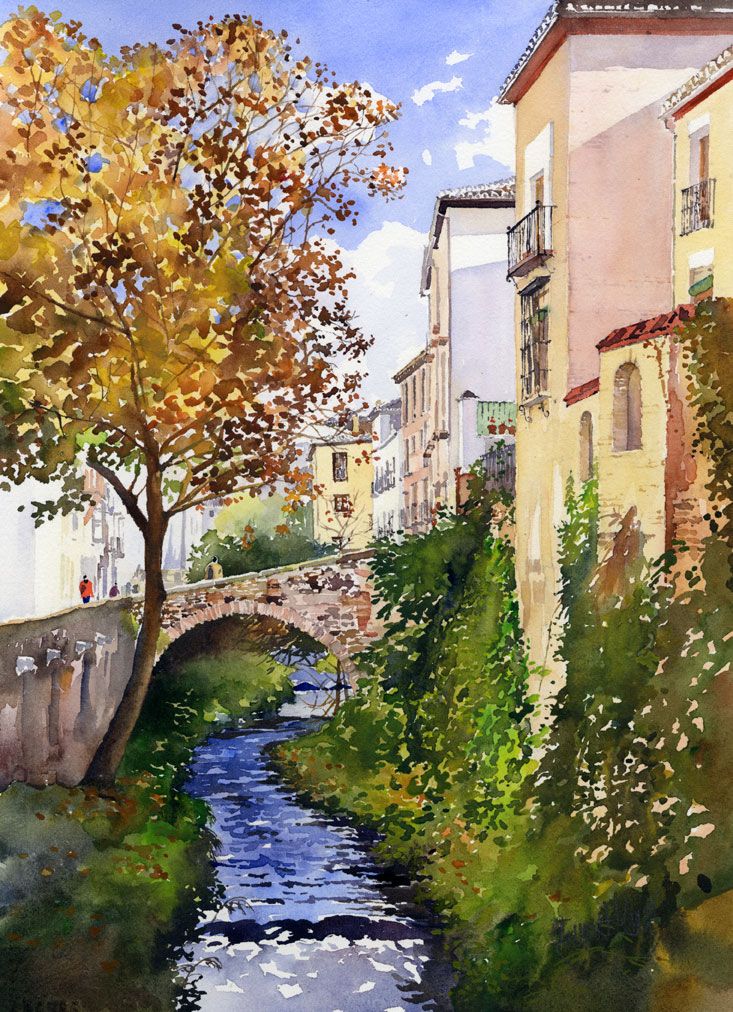
En su nuevo álbum, Granada recibe a Raúl con luz de primavera, le pone entre las manos el sol de Plaza Nueva; mientras, le dice que le quiere la Torre de la Vela y descubre en su perfume barquillos de canela. Luego resbala por el hilo que alcanza una cometa, porque hay magia por el aire rondando en las aceras (1).
Y es que Raúl Alcover no es un músico más, sino un cantautor lírico granadino que ha sobrevivido a décadas de cambios en la industria, manteniendo intacta su esencia. Los premios, reconocimientos y nominaciones están ahí, aunque lo que realmente cuenta es su apertura a mezclar géneros preservando el alma musical de su ciudad.
Desde los quince años, cuando se metió de lleno en el colectivo cultural andaluz Manifiesto Canción del Sur, ya estaba claro que no iba a ser un artista de manual: era un inconformista, un explorador de sonidos. Su versatilidad es muy amplia: folk, flamenco, bossa nova, jazz, pop, rock, balada… todo cabe en su universo.
Artistas como él no hacen música solo para complacer, sino por compromiso social y necesidad vital. Su nuevo trabajo Toda la noche oyeron pasar pájaros fue presentado en octubre de 2025, y estará disponible en CD en enero de 2026. Ha sido producido por Pablo Salinas.
Con todo lo anterior en mente, y con la mayoría de las preguntas centradas en este último álbum, comienzo mi entrevista:
MARÍA: Raúl, primero me gustaría que volviéramos a tus inicios como músico. Creo que tenías quince años cuando te uniste a Manifiesto Canción del Sur ¿es correcto? ¿Cómo recuerdas aquel momento?
RAÚL: Me uní a Manifiesto con apenas quince años y supuso despertar mi conciencia andaluza y pelear por mi tierra.
M: Tu apellido es Alcover y has comentado antes que tu familia viene de Granada y de fuera de Granada ¿por casualidad tienes algún parentesco con el poeta mallorquín Joan Alcover?
R: Que yo sepa no. De todos modos Alcover es un apellido común en las zonas catalana y mallorquina.
M: En tu obra hay una presencia constante de la poesía. Sé que has trabajado con versos de Lorca y de Javier Egea. ¿Qué lugar ocupa para ti la poesía dentro de la música? ¿Crees que la poesía es un territorio paralelo al de la música, o que ambas se funden en un mismo fluir de expresión?
R: Hago canciones que como sabes se componen de letra y de música. Cuido la letra tanto o más que la música. Y van de la mano.
M: Sí, se nota… Por cierto, en este último trabajo ¿quién es el autor de la letra de las canciones?
R: Las letras son mías excepto Rastros (3) y Ella no sabía nada (2)…de Javier Egea. El disco llevará más temas. Es un adelanto y un guiño a Javier, con el que hice Noche canalla, una de mis canciones más famosas y mejores.
M: ¿La musicalización de Noche canalla ocurrió antes de la tragedia de Javier o a posteriori?
R: Mucho antes de morir…En 1981. Noche Canalla nace independiente. La Tertulia organiza un concurso de letras de tango argentino en Granada y se decide que quien debe poner música a la letra ganadora sería yo. Y ganó Javier con ese poema.
M: ¿Entonces Noche Canalla es un tango? Fantástico…
R: Que yo hice balada.
M: Otra musicalización tuya de un poema de Javier Egea, Ella no sabía nada (2), la acabo de oír; tu musicalización y la grabación la hacen todavía más especial, qué belleza.
R: Quería hacer de ella una breve sinfonía.
M: ¿Quién ha diseñado la portada de Toda la noche oyeron pasar pájaros?
R: La portada y diseño del disco es obra de Lady Desidia.
M: Gracias por responder a las preguntas de El Artca.
R: Gracias María.
………………………..
Graná es de grana: tanguillos granadinos con toque de cumbia, letra y música R. Alcover (1)
A la deriva, pop-blues letra y música Raúl Alcover
Ella no sabía nada, sinfonía breve de Raúl Alcover con letra de Javier Egea (2)
Teresita, vals-bulería inspirada por la pianista colombiana Teresita Gómez, letra y música R. Alcover
Rastros, bossa nova: música de R. Alcover, letra Javier Egea, guitarra Miguel Ángel Corral (3)
Geología, rock sinfónico inspirado tras leer un relato de María Alcázar, letra y música R. Alcover (4)
THE MUSICIAN THAT CARRIES THE SUN OF PLAZA NUEVA IN HIS HANDS
By María Martínez Sánchez
In his new album, Granada welcomes Raúl with spring light, it puts the sun of Plaza Nueva in his hands, while telling him that the Torre de la Vela loves him, and he discovers cinnamon wafers on its perfume. Then he slides down the thread that reaches a kite, because there is magic in the air singing on the sidewalks. (1)
Because Raúl Alcover is not just another musician but a lyrical songwriter-singer from Granada who has survived decades of changes in the industry, keeping his essence intact. The awards, recognitions and nominations are there, although what really counts is his openness to mixing genres while preserving the musical soul of his city.
From the age of fifteen, when he fully immersed himself in the Andalusian cultural group Manifesto Canción del Sur (Manifesto Song of the South) it was already clear that he was not going to be a standard artist: he was a nonconformist, an explorer of sounds. His versatility is very wide: folk, flamenco, bossa nova, jazz, pop, rock, ballads… everything fits in his universe.
Artists like him do not make music just to please, but out of social commitment and vital necessity. His new work, Toda la noche oyeron pasar pájaros (All night they heard birds passing by) was presented in October 2025 and it was produced by Pablo Salinas. It will be available on CD in January 2026.
With all this in mind, and with most questions concerning this latest album, I begin my interview:
MARÍA: Raúl, first I would like us to go back to your beginnings as a musician. I think you were fifteen years old when you joined Manifesto Canción del Sur, is that correct? How do you remember that moment?
RAÚL: I joined Manifesto when I was barely fifteen years old and it meant awakening my Andalusian conscience and fighting for my land.
M: Your last name is Alcover, and you have mentioned before that your family comes from Granada and from outside of Granada, are you by any chance related to the Majorcan poet Joan Alcover?
R: Not that I know of. In any case, Alcover is a common surname in the Catalonian and Majorcan areas.
M: In your work there is a constant presence of poetry. I know that you have worked with verses by Lorca and Javier Egea. What place does poetry occupy in your music? Do you think that poetry is a parallel territory to that of music, or that both merge into the same flow of expression?
R: I compose songs that, as you know, are made up of lyrics and music. I care about the lyrics as much or more than the music. And they go hand in hand.
M: Yes, it shows… By the way, in this latest work, who is the author of the lyrics of the songs?
R: The lyrics are mine except for Rastros (Footprints) (3) and Ella no sabía nada (She didn’t know anything) (2) by Javier Egea. The album will have more songs. It is a preview and a nod to Javier, with whom I made Noche Canalla (Rogue night), one of my most famous and best songs.
M: Did the musicalization of Noche canalla happen before Javier’s tragedy or afterward?
R: Long before he died…In 1981. Noche Canalla was born independent. La Tertulia organizes an Argentinian tango lyrics contest in Granada and it is decided that the person who should set the winning lyrics to music would be me. And Javier won with that poem.
M: So Noche Canalla is a tango? Fantastic…
R: That I made a ballad.
M: Another musicalization of yours of a poem by Javier Egea, She didn’t know anything (2), I just heard it; your musicalization and the recording make it even more special, what a beauty.
R: I wanted to make it a short symphony.
M: Who designed the cover of All Night They Heard Birds Going By?
R: The cover and design of the album is the work of Lady Desidia.
M: Thank you for answering El Artca’s questions.
R: Thank you Maria.
……………………………
Geology (lyrics by Raúl Alcover) (4)
I contemplate on the mirror the geology of my image, the bark cracks of the passing of the years with the shadows of earthquakes I have lived, the kisses of oblivion, the marks of much laughter and disappointment, the creases guard my eyes, in my eyelids, signals of sadness and joy, in between my eyebrows there are faults reversed in harmony. Now I am soil in evolution, rock that does not provoke any wind of jealousy, nor does it make to doubt, and consience and reasoning are the ones who marked my forehead with their mineral finger, with their mineral finger. I discover on the mirror and on my face an atom of time, a valley of sanity, a river of enthusiasm and freedom, an unforgettable volcano of passion. And even though the mirror does not speak, it knows my earthquakes are born in the human depths of the heart, I search without fear my face on the mirror, and point at the path my tears should follow, the grooves they would open until they reach my mouth salted with sea drops.
Nacida en Leópolis, Ucrania, es doctora en literatura ucraniana y profesora de estudios literarios. Su investigación se centra en la literatura medieval.
En su poemario Curso intensivo en cócteles molotov (A Crash Course in Molotov Cocktails) encontró las herramientas poéticas para digerir la violencia y el horror de la guerra. Su poesía es estratificada, de un lirismo introspectivo. Tanto el poemario original como su traducción al inglés, de Amelia Glaser y Yuliya Ilchuk, han sido finalistas de varios premios literarios.
Perderse en la Vida (Lost in Living) presenta el trabajo inédito de los años inmediatamente anteriores a la invasión, cuando la vida en Ucrania estaba marcada por la agitación pero la guerra a gran escala aún no se había normalizado. Ha traducido obras de otros escritores del polaco al ucraniano y ha publicado literatura para niños. Kruk participará en el Salón de Poesía de FIL Guadalajara 2025 los días 2 y 3 de diciembre.
nuestro refrigerador desconectado
te amo desde todos los lugares.
todavía hay mucho territorio por explorar,
puedes seguir y seguir, hasta que tu frente choque
con los imanes del refrigerador,
traídos de varios países: no estuvimos juntos aquí, ni allá,
y te envié fotos y textos desde aquí, y te llamé desde allá,
un paisaje espectacular, una nutria de dientes amarillos, un bosque de bambú
que solo se alzaba y se alzaba, cuidando la Tierra,
entonces un día empezó a crecer y se elevó muy alto.
la lista de las ciudades que tenemos que ver
cuando todo esto termine se ha vuelto tan larga
que me pregunto al alba en un país extranjero,
en algún hotel, desde una cama incómoda:
¿nos quedará suficiente vida para ver toda la lista?
¿tendremos suficiente espacio en la cabeza
para todo este extraño crecimiento?
¿tendremos suficiente fuerza para todo esto?
«hay algo de lo que no tienes que preocuparte,» bromeas, «que cuando ya no tengamos más espacio para imanes, compremos un refrigerador más grande.»
te amo desde todos los lugares.
vuelvo a ti desde cualquier lugar, como un imán
Traducción del inglés: Mar Martínez, poema original de Halyna Kruk, traducción ucraniano-inglés de Amelia Glaser y Yuliya Ilchuk
Born in Lviv, Ukraine, she holds a doctorate in Ukrainian literature, is a professor of literary studies, and her research focuses on medieval literature.
In her poetry collection A Crash Course in Molotov Cocktails, she found the poetic tools to process the violence and horror of war. Her poetry is layered, with an introspective lyricism. Both the original collection and its English translation by Amelia Glaser and Yuliya Ilchuk have been finalists for several literary awards.
Lost in Living presents previously unpublished work from the years immediately preceding the invasion, when life in Ukraine was marked by turmoil but full-scale warfare had not yet become the norm. She has translated works by other writers from Polish into Ukrainian and has published children’s literature. Kruk will participate in the Poetry Salon of FIL Guadalajara 2025 on December 2nd and 3rd.
our unplugged refrigerator
i love you from all the places.
there’s still a lot of uncharted territory,
you can go on and on, until your forehead hits
the refrigerator magnets,
brought from various countries: we weren’t together here, or there,
and i sent pictures and texts from here, and i called you from there,
a spectacular landscape, a yellow-toothed otter, a bamboo forest
that just stood and stood, guarding the earth,
then one day it began to grow, and shot way up overhead.
the list of cities we must see
when all this is over has grown so long
that i ask myself at dawn in a foreign country,
in some hotel, in an uncomfortable bed:
will we have enough life left for the whole list?
will we have enough headspace
for all that freakish growth?
will we have enough strength for it all?
«there’s one thing you don’t have to worry about,» you joke, «if we run out of space for magnets, we’ll buy a bigger refrigerator.»
i love you from all the places.
i return to you from everywhere, like a magnet
Translation from the Ukrainian by Amelia Glaser & Yuliya Ilchuck, written by Halyna Kruk
Poem musicalized in Sunowith Lyrics by Brisa Cósmica
Por Brisa Cósmica
La belleza está
en la generosidad
de los extraños
.
La belleza son abrazos
dispersos en el caos
.
La belleza es
un beso virtual
yendo al espacio
y aterrizando en tus labios
.
La belleza es pensar
que vas al cielo y desciendes
en una nube de amor
.
La belleza es sentir
la arena fresca
bajo tus pies
.
La belleza es
el aroma
de la flor de azahar
en primavera
.
La belleza es la nostalgia
de un violín
sosteniendo las notas
.
La belleza es compartir un sueño
.
La belleza es el amor filial,
eterno y solidario
.
La belleza es
cuidar la Madre Tierra
.
La belleza es inventar
formas de amar el mundo
.
La belleza es….
———————
Poema musicalizado en Sunocon Letra de Brisa Cósmica
——————–
Images created with WordPress image creator- Imágenes creadas con creador de imágenes de WordPress / Author translation English to Spanish – Traducción de autor inglés a español
Cae la noche sobre bakeries y supermercados, un ángel blanco cruza la calle desplumado por la crisis entre automóviles veloces y furiosos.
¿En qué parte del cielo viven los ángeles hambrientos ? ¿Dónde residen los que ya no son ángeles?¿Dónde residen los hijos de dios? El dios que buscan y no encuentran. El dios que se ha perdido. El dios de los sin nombre. El dios de los encarcelados. El dios de los immigrantes. El dios de los desahuciados.
El ángel sin plumas blancas busca a dios, mira al cielo: solo nubes, espacio…nada más.
Cae la noche sobre calles y avenidas gentrificadas por los que sí tienen nombre: Jaime… abogado, hospital… ayudando a los niños a encontrar curas, una comunidad de residentes en Hialeah…
Cae la noche sobre calles y avenidas, ¿calles y avenidas vacías de gente? No, vacías de esperanza. Los buenos hablan mucho, hacen poco. Los malos ya no hablan, solo hacen. El imperio se desploma y nadie va a venir a salvarlo: ni siquiera dios.
Musicalización en Suno
By Cosmic Breeze
Night falls over bakeries and supermarkets, a white angel crosses the street fleeced by the crisis among fast and furious automobiles.
Where in heaven do hungry angels live? Where do those who are no longer angels reside? Where do the children of god reside? The god they seek and they don’t find. The god that has been lost. The god of the unnamed. The god of the imprisoned. The god of the immigrants. The god of the hopeless.
The angel without white feathers seeks God, looks at the sky: only clouds, space…nothing else.
Night falls over streets and avenues gentrified by those who do have a name: Jaime… lawyer, hospital… helping children find cures, a community of residents in Hialeah…
Night falls over streets and avenues. Streets and avenues empty of people? No, empty of hope. The good ones talk a lot, do little. The bad ones no longer talk, they only do. The empire is collapsing and no one will come to save it: not even God.


















 EL ARTCA