

Por Armida Reed
Samer Abu Hawwash es un poeta y traductor palestino conocido por su obra lírica y su labor como puente entre culturas. Nació en Líbano en 1972 en el seno de una familia refugiada palestina. Residió y trabajó en Emiratos Árabes Unidos, donde se especializó en poesía estadounidense y ficción en lengua inglesa, traduciendo obras de autores como Marilynne Robinson, Charles Bukowski, Langston Hughes, Jack Kerouac y Hanif Kureishi.
Ha publicado alrededor de diez volúmenes de poesía, siendo su colección debut La vida se imprime en Nueva York, 1997, y posteriormente Te mataré, muerte, 2012, Último selfie con un mundo moribundo, 2015, Felicidad o una serie de explosiones que sacudieron la capital, 2007, Así no se hace la pizza, 2016, y Ruinas, 2024.
Su poesía aborda temas como el exilio, la identidad, la memoria, la infancia y la resistencia. Su estilo es íntimo, directo y profundamente humano. Recientemente la revista Banipal le dedicó un número especial en español, publicando su poemario Desde el río hasta el mar, traducido por María Luisa Prieto.
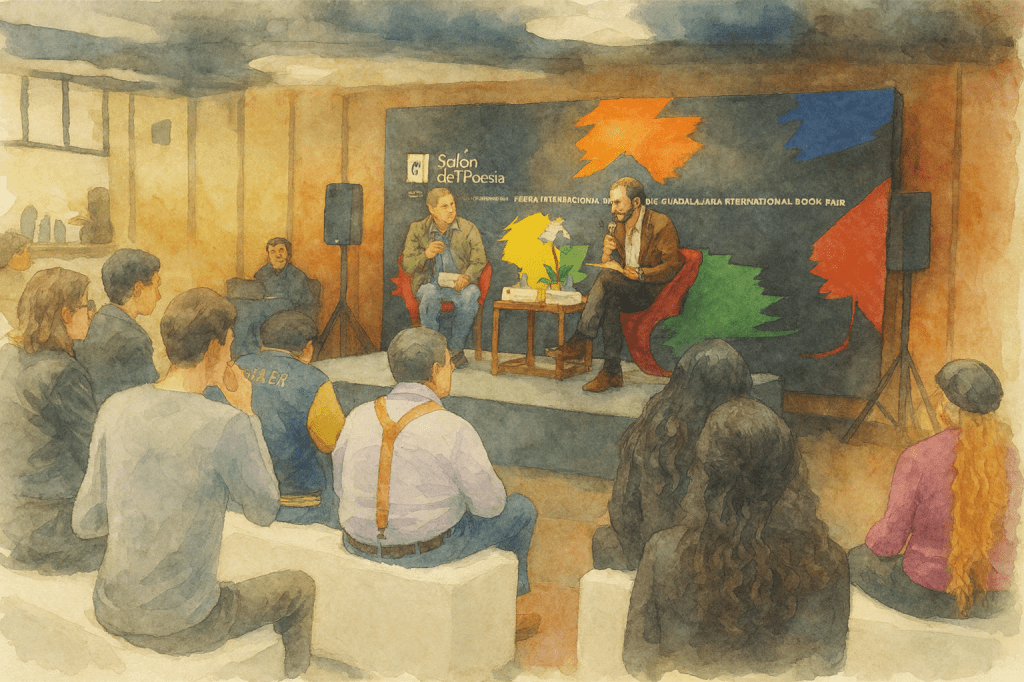
Sus poemas fueron presentados en el Salón de la Poesía en la FIL Guadalajara, considerada la feria editorial más grande de Iberoamérica, en diciembre de 2025
——————
PEQUEÑOS CADÁVERES
Éste es el tiempo de los cadáveres. No tienes que decir nada. Sólo tienes que mirar en cualquier dirección y verás otro cadáver, un cadáver sin nombre porque no le dieron tiempo suficiente para que su nombre se pegara en él, un cadáver neutral porque no le dieron tiempo suficiente para pensar en lo que pasó, un cadáver muy pequeño, como un bulto preparado deprisa para partir.
¿Y hacia dónde parten los pequeños cadáveres?
La vida real sucede en las ciudades, en los mercados, en aceras reparadas, en calles preparadas para los turistas. Los cadáveres pequeños atraviesan una multitud invisible. Los cadáveres pequeños se agarran de la mano para no perderse. Cadáveres pequeños que no duermen. Continúan marchando entre ciudades, por continentes, por bosques. Y cada vez que nace un nuevo cadáver, encuentra una mano pequeña que lo guía con los ojos cerrados.
Poema original de Amed Abu Hawwash. Traducción del árabe: María Luisa Prieto/ Fotografías de Lunnático (Editadas)
By Armida Reed
Samer Abu Hawwash is a Palestinian poet and translator known for his lyrical quality, and his work is seen as a bridge between cultures. He was born in Lebano into a Palestinian refugee family in 1972. He lived and worked in the United Arab Emirates, where he specialized in American poetry and English-language fiction, translating works by authors such as Marilynne Robinson, Charles Bukowski, Langston Hughes, Jack Kerouac, and Hanif Kureishi.
Hawwash has published around ten volumes of poetry, beginning with his debut collection Life is Printed in New York, 1997, and later, I Will Kill You, Death, 2012, Last Selfie with a Dying World, 2015, Happiness or a Series of Explosions That Rocked the Capital, 2007, This Is Not How Pizza Is Made, 2016, and Ruins, 2024.
His poetry addresses themes such as exile, identity, memory, childhood and resistance. His style is intimate, direct and deeply human. Banipal magazine dedicated a special issue to him in Spanish, publishing his collection of poems From the river to the sea, translated by María Luisa Prieto.
His poems were presented at the Poetry Hall at the FIL Guadalajara, considered the largest publishing fair in Latin America, in December 2025
——————
SMALL CORPSES
This is the time of corpses. You don’t have to say anything. You just have to look in any direction and you’ll see another corpse, a nameless corpse because they didn’t give it enough time for its name to stick to it, a neutral corpse because they didn’t give it enough time to think about what happened, a very small corpse, like a bundle hastily prepared to go.
And where do the small corpses go?
Real life happens in cities, in markets, on repaired sidewalks, on streets prepared for tourists. Small corpses pass through an invisible crowd. The small corpses hold hands so as not to get lost. Small corpses that do not sleep. They continue marching between cities, across continents, through forests. And every time a new corpse is born, it finds a small hand that guides it with its eyes closed.
Original poem by Amed Abu Hawwash. Translation from English: Armida Reed – Images by Lunnático (Edited)

 EL ARTCA